

No products
FAQ
- How the Balanced armature driver works
- How to choose a right helmet size
- Fiberglass or carbon fiber?
- How to choose a right microphone
- What are the dual-coil speakers
- How the active noise reduction works
- How to choose a right plug type
- How to NC-BT/ANR module works
- Headsets compatibility
- Which Aviation Headsets to Choose?
What to look for when choosing aviation headsets:
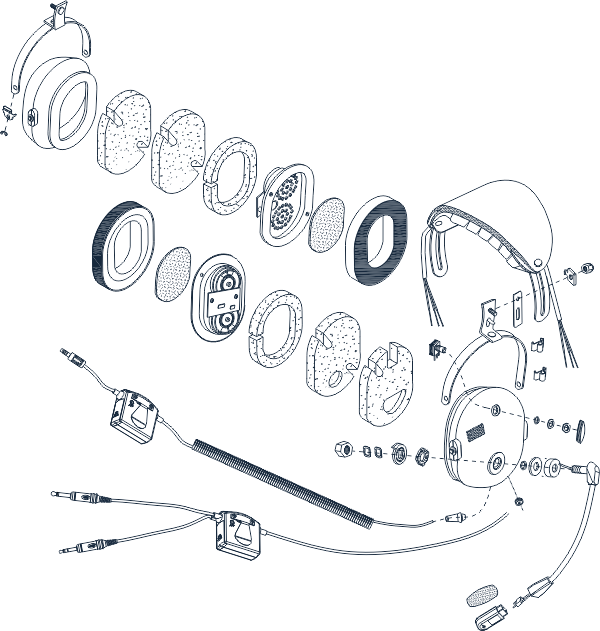
Which aviation headsets to choose? This question must be asked by all pilots at least once in their lives. While the answer becomes easier with each hour flown, certain doubts may arise at the beginning of a aviation career, which the following article will help to resolve.
The main purpose of aviation headsets is to provide voice communication both on board the aircraft between crew members and outside it, with other users of the airspace and its supervision (tower, approach, square, etc.). Since in most cases such communication takes place in an environment with increased noise intensity (aircraft cabin), aviation headsets must also provide noise reduction. There are two ways to reduce external noise:
- By physically isolating your ears from the source using shielding earpieces or earplugs? so-called passive attenuation
- By using electronic systems that generate sounds in antiphase? so-called active attenuation (read more about this in this article: How does active attenuation work)
Which attenuation to choose? In most cases, active attenuation aviation headphones are better than passive attenuation headphones? They provide a higher level of noise reduction. However, there are situations in which it is better not to use active attenuation. This occurs at the beginning of flight training, when we should listen carefully to all the sounds generated by the aircraft and its equipment. Of course, most active noise cancelling headphones have the option of deactivating this function, so we can decide when to use it and when not. So if the higher price for active noise cancelling aviation headphones is not an obstacle for us, we should decide on them. There are two other ways to solve this dilemma - we buy passive headphones and over time equip them with active electronics (such a chance is provided by NAVCOMM NC-150, NC200 and NC300D headphones), or at the stage of training for a tourist license (PPL) we decide on passive headphones, which after obtaining the license we change to an active version, and the previously used passive noise cancelling headphones are intended for a passenger or as a spare.
Type of construction. Here we can distinguish the following categories:
Generally, the lower the weight of aviation headphones, the better, but it should be remembered that especially in the case of headphones with passive attenuation, the thickness of the shielding earpieces themselves significantly affects the level of attenuation, so lightweight earpieces with thin walls will attenuate worse than their heavier, thicker counterparts. It is better to reduce the weight by using a lighter headband (NC-100 and NC-150 models) or another material, e.g. carbon fiber (NC-300CE) than to "slim down" the earcups themselves. The weight of the headphones usually also translates into their structural strength. If we know that the headphones will be heavily used in difficult conditions, it is sometimes worth sacrificing these few dozen grams at the expense of their longer service life. Another weight alternative are the so-called ultralight headphones (NC-400U), which weigh ten times less than classic headphones with earcups, and thanks to the earbuds perfectly matched to the ear canal, they guarantee attenuation similar to headphones with active attenuation. In ultralight aviation headphones, the traditional shielding earcups have been replaced with an earbud. Since the thickness of such an insert can be much greater than the walls of the earcups, the level of attenuation is also significantly better - comparable to active attenuation. However, this applies only to